
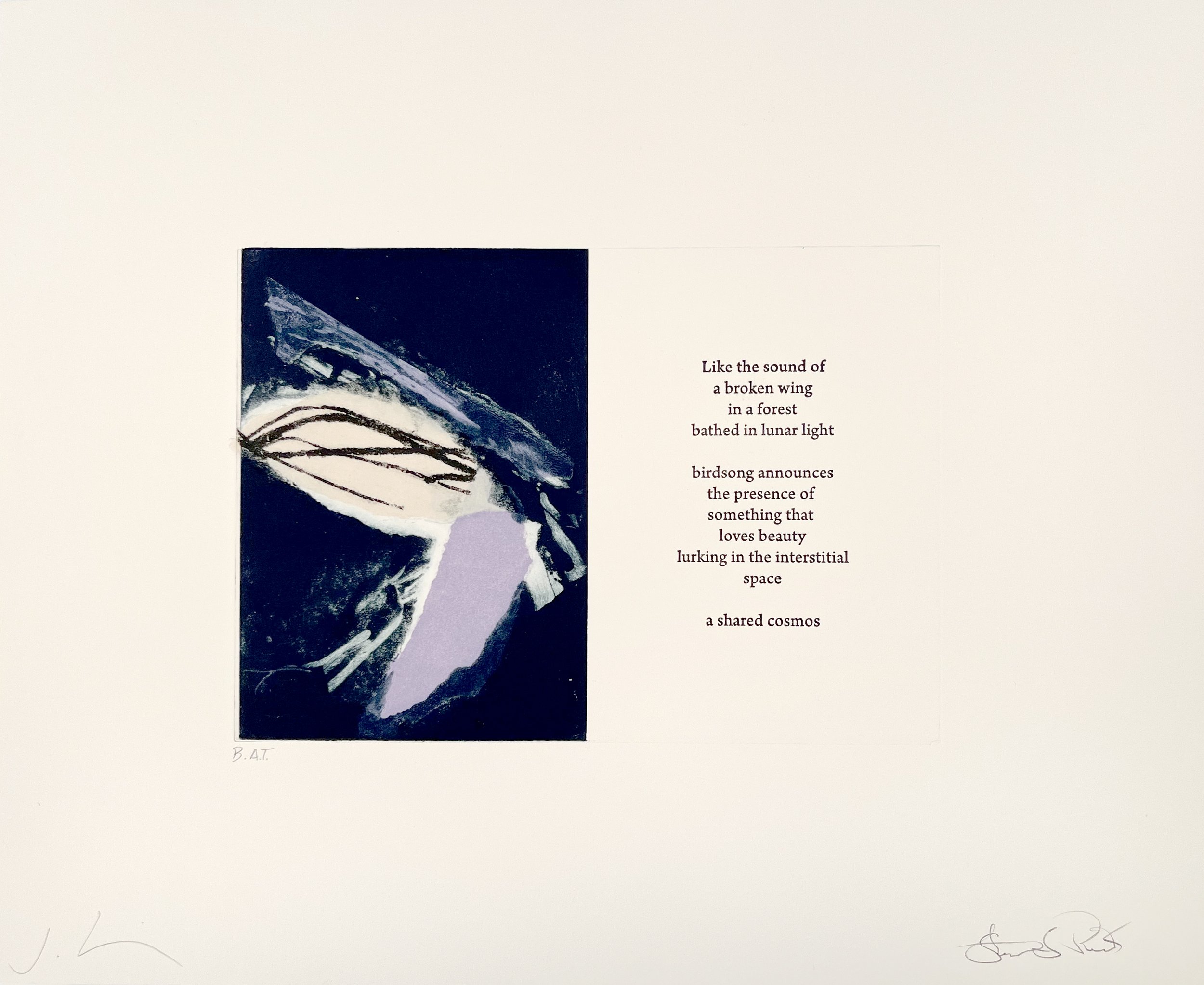
Jackie Leishman (American, born 1979) and Steve L. Peck (American, born 1957)
Sound of a broken wing (2024)
3-color intaglio print with chine-collé, 14 x 17 inches, printed by Todd A. Smith, Press Works, on Stonehenge Cream
Edition of 20, plus AP and PP
Jackie Leishman and Steve Peck's work is a collaboration—a fusing of art and poetry between an artist and a scientist. Their work grew out of a shared love of nature, science, ideas, experimentation, art, and literature.
Their first bodies of work, DeCreation and Absence, explored the unraveling of life's evolutionary history and the importance of forests. That work confronted a rapidly changing world, an unpredictable climate, a decline of species, and all within a context of a raging debate over what is true.
Their collaborative project has since continued, and their new body of work, Emergence, now explores possibility, wonder, and spiritual brigadoons. It is just beginning. After two bodies of work immersed in tragedy, they wanted to shift focus. They want to leave space for unexpected delight and inspiration. And once again, they are using nature as the gateway, but this time as an entrance into hope.
The printing process:
This edition started with an original monotype collage created by Jackie and a poem written by Steve. The monotype collage is scanned at high resolution, and each color is digitally separated and converted into a black-and-white image. These images are then transferred onto film transparencies, which are processed onto photopolymer plates. Three separate plates are used for the colors, and a fourth plate is dedicated to the text of the poem.
The color plates are printed using traditional intaglio techniques. Each plate is inked, wiped, and printed sequentially. For the second plate, a piece of Japanese Washi paper is incorporated through a process called chine-collé. Wheat starch paste is applied to the back of the Washi paper and allowed to dry. The Washi is then lightly misted with water and placed on the inked plate. After passing through the etching press, the Washi paper adheres to the print paper. Finally, the text plate is treated as a relief plate, inked on the surface, and printed by hand using a heavy roller.