Curating Christ: Rose Datoc Dall's Expressions of Jesus
December 19, 2025 | Listen to the podcast | Watch on youtube
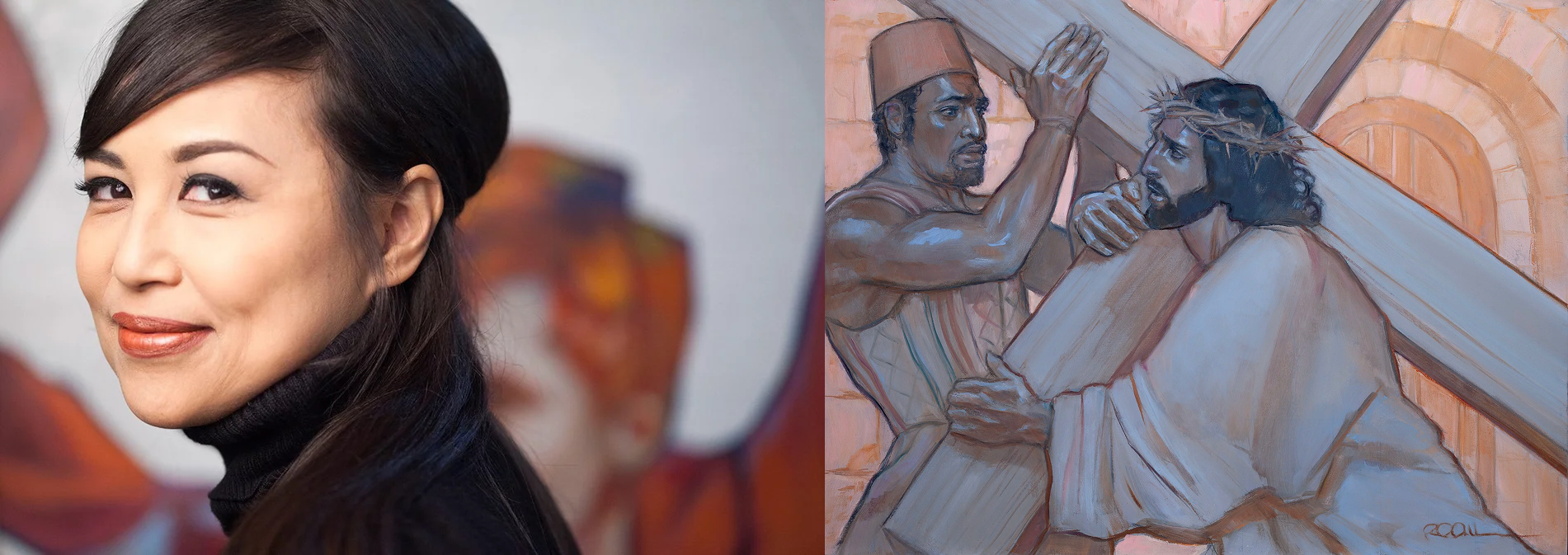
Home and Studio
Glen Nelson: It's my pleasure to welcome Rose Datoc Dall to the podcast. Hello, Rose.
Rose Datoc Dall: Thanks for having me.
Glen Nelson: Well, I’ve followed your career over many years, and I'm so excited to talk to you today about your work. Thanks for chatting with me. Now for our listeners, where are you right now? Where are you sitting?
Rose Datoc Dall: I am sitting at the top of a mountain in our home in Woodland Hills, Utah. Which is, if you know anything about Utah, it's about half hour south of Provo, it's near Spanish Fork.
Glen Nelson: And are you in your studio?
Rose Datoc Dall: I am in my studio.
Glen Nelson: You know, I'm jealous of anyone who has one of those things because I live in New York and, you know, a studio apartment means that's where everything is, not just where we paint art. It's like, that's the whole... our 300 square foot, that's it. So, what is your studio like?
Rose Datoc Dall: Well, we've lived in this home since 2021, and I had the opportunity to design our home. And I designed it with the intention of making this both home and an art studio, and it has an art gallery in the home as well.
So my studio right now, I'm actually in the upper loft portion of my studio. So it's two levels. And this is the office portion. And the working part of the studio is downstairs. It's a big space. I'm really grateful to have this space. I was able to design it to sort of go with my workflow.
I've been really grateful for that because for years, for 24 years, I had my studio in the basement of our home in Virginia. And it was not ideal because it was a family space as well and a living space. So it was kind of awkward and the ceiling was probably only, I don't even think they were nine foot ceilings. So it was a challenge doing large work. And so I'm really grateful to have this space.
Glen Nelson: Have your works got larger since you moved into a larger space?
Rose Datoc Dall: Yes, they've gotten larger, and one of these days I'll be able to do some sculpture. It’s been on my radar. I've been itching to get my hands on doing some 3D work now that I have some room for it.
Glen Nelson: I’d love to talk with you a tiny bit about how your whole life with art started. When did you first become interested in making it? Was there somebody who kind of encouraged you or pushed you in that direction? How would you describe that?
Rose Datoc Dall: I've been very fortunate to have encouraging parents. I am Filipino, and it's kind of typical for Asian families to really push their children into medicine or technology or something in science. But my oldest brother went that route. My parents were physicians. My oldest brother is radiologist.
But then the rest of us, we kind of have followed our own path. And I've always been inclined towards the arts. I'm a little bit of a black sheep that way—not in a rebellious sort of way, but just different. I think I'm the right-brained member of my family. And so I've always been inclined towards all things creative, whether it's dance, theater, visual arts, and film videography. I thought I was going to go into film, but I ended up getting my art degree in fine art studio and art history of all things, where I thought I was really going to go in the direction of film. But, you know, to this day, I think film cinematography has informed my art because I think I compose my images like a cinematographer. Yeah, I love everything about film, even film posters and their very graphic quality and that has always impacted my art. As well as art history, I have a love of just the history of art. I think it's really important to know what you've inherited in terms of what's gone before because all of that's brought to the table. You've inherited it all. You have to know a bit about it to know what's relevant to you, what you want to incorporate, discard, what inspires you, what doesn't inspire you.
Glen Nelson: That's amazing.
Rose Datoc Dall: All those things kind of inform me as an artist.
Glen Nelson: So where did you go to college to study these things?
Rose Datoc Dall: I went to Virginia Commonwealth University, also known as VCU Arts in Richmond, Virginia. So probably not known to many folks out here in the West, but it's definitely a more recognizable name on the East Coast.
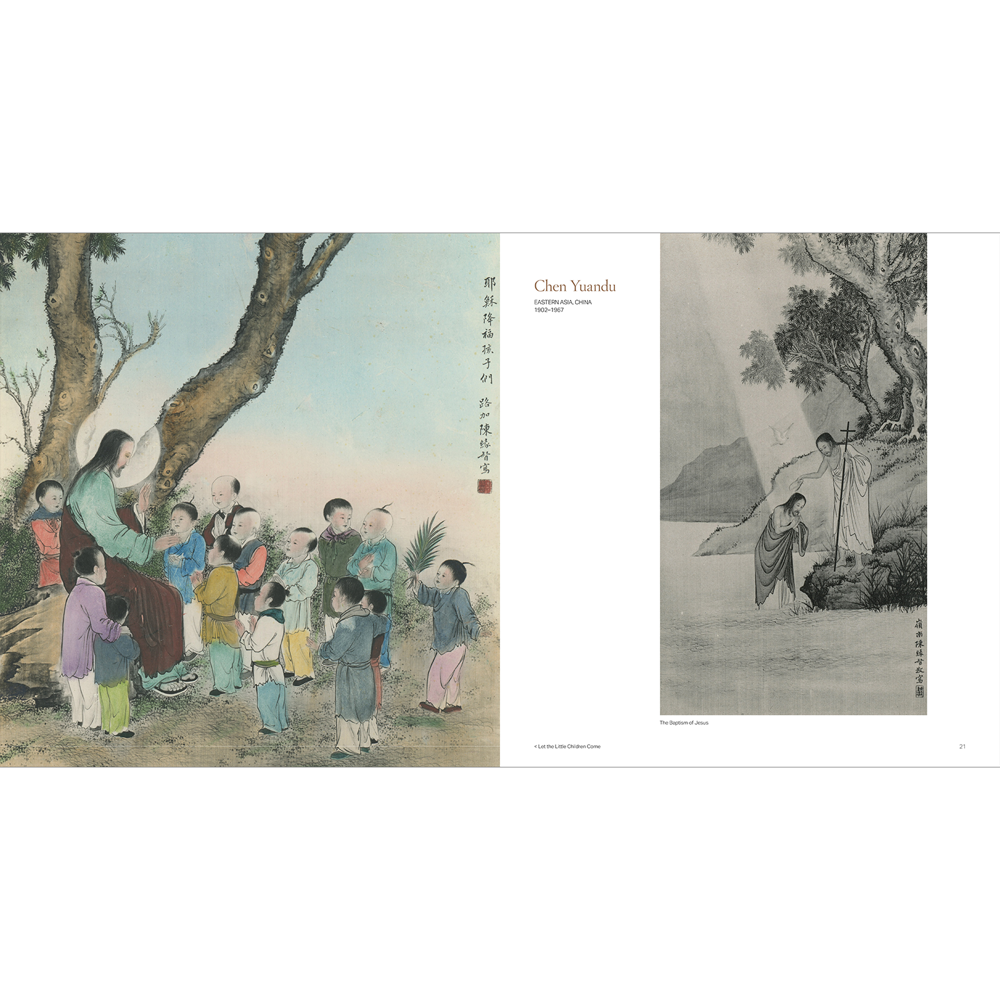
An inside look at Expressions of Jesus, curated by Rose Datoc Dall
Expressions of Jesus
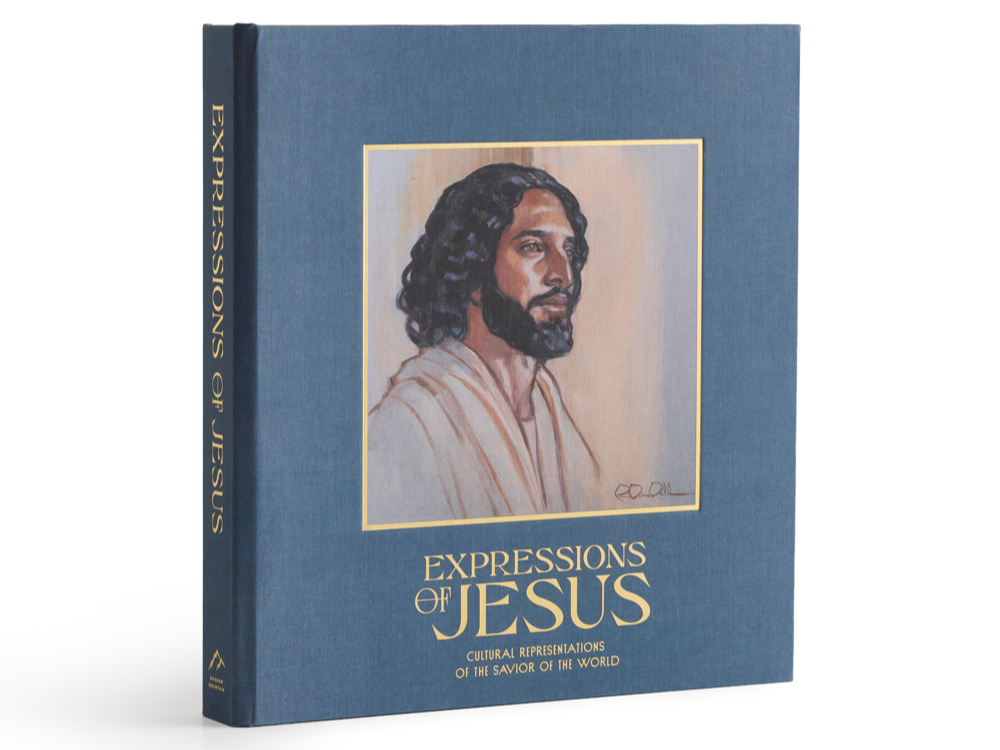
Glen Nelson: Now let's jump a little bit to the present. Your painting is on the cover of a new book, Expressions of Jesus, that was published by Shadow Mountain Press recently. Can you tell us a little bit about the book and how you became involved with it?
Rose Datoc Dall: Sure. So, Dallen Wright, who's a product manager over at Deseret Book, and Laurel Day, who's Deseret Books president, and Chris Schoebinger, who's publisher with Shadow Mountain, they approached me with this project and they said we would really love an artist to curate this book. And I thought, really? You don't want like a scholar with a PhD?
They specifically wanted me to curate these images, and they wanted a collection of diverse images of Jesus. And I'm not really even sure if at the outset they, that any of us knew what the outcome would be. But I felt very strongly that this isn't just a collection of contemporary, diverse images of Jesus, but we needed to go back all the way to antiquity and then to make this as broad a suite of images from all over the world and to collect images from all cultures. And so if you really want to know where all these images came from, here's my list. My list of images come from: Russia, Ukraine, Bulgaria, China, Korea, Japan, Cambodia, Indonesia, the Philippines, India, Uganda, Ethiopia, Ghana, Peru, Mexico, Argentina, France, Italy, Spain, Germany, Denmark, as well as America. And then, you know, from ancient Greece and ancient Italy, Syria, and Egypt.
And we have Antiguan, Native American, Indigenous Canadian, Chilean American, Filipino American. I hope I'm not leaving out any. It gives you an idea of the breadth of Christian art coming from all over the world.
Glen Nelson: Describe the book. You've got a lot of images. How many images are we talking in? Is it largely images or what kind of text is part of the book?
Rose Datoc Dall: So it primarily is images with, interspersed with bits of text. We're not talking like essays or anything. We're talking quotes. You know, Laura was insistent that the way that we approach this book and especially in the timeframe that it came together. Now, this is not years’ worth of research. This book came together in a matter of eight months! In the world of publishing that's almost unheard of, and so in some ways kind of miraculous, you know, especially when you're talking about getting rights. To answer your question about how much artwork is in there, there are works from 104 artists and a third of which are Latter-day Saints. So the rest of it comes from everywhere, from Christians everywhere. And we have anywhere from like two to three images, maybe four from each artist. So we're talking about three or four hundred images in the book and getting the rights to all those images, again, that was kind of miraculous because that's a lot, that's a lot.
Glen Nelson: Okay, that's a good sampling.
Rose Datoc Dall: And of course, you know, a lot of the images we were able to get from artists who have been deceased for over 100 years, so that's sort of open source. But by and large, most of the artists were thrilled to participate. But really, the scope of the book is, the idea behind this book is to show different cultural representations of Jesus.
Glen Nelson: Really.
Rose Datoc Dall: And that's why it's called Expressions of Jesus. The book is not organized by time period or region. I was kind of insistent on that, but I lost that battle with Laurel Day. Laurel really wanted this to feel like a collection that didn't give weight to one particular art style or one particular region but to give equal weight to all the art. So it's a surprise on every single page and it's really beautifully textured that way. It's a stunning collection.
Glen Nelson: Wow.
Rose Datoc Dall: When I got the book in my hand, I was floored by this book. And really the overarching thing that I learned from working on this book—and I'd never done this before, even as an art historian that studying art history—I never looked at Christian art as a whole, including contemporary Christian art. I didn't even think, you know, back when we joined the Church in the 1980s, I didn't even know that Christian art was still a thing. I thought that was a dead art.
But to see it, especially coming from our Latter-day Saint culture, that religious art, sacred art is a living thing and to be part of it, and to sort of watch this unfold to look at Christian art. The one word that I'm going to borrow from one of the artists, his name is Hu Chen, and he's one of several Chinese painters in this book who are traditionalists, and they do traditional ink wash painting, and they bring that to their Christian art. So you see Jesus is Chinese and the stories take place in Chinese village, Chinese apostles. And the same thing I see with, let's say, Ethiopian Christian folk art, where all of Jesus and the apostles are African, they have African features.
The word that I'm borrowing from Hu-Chen is contextualization. And what that means is that the artists are using their…, they're portraying, they're using their own visual vernacular from their own culture, a visual language that's familiar to their people to portray the stories of Jesus so that it would relate. These stories would come to life for their own people, their own culture. And then when I found that if that's true for Chinese traditional ink wash painting or for Ethiopian Christian folk art, it's true for European art such as Carl Bloch, who paints Danish models, a Danish Christ, or Caravaggio, who uses Italian models and a Baroque period costume for his figures. And I would say that's also true for our Latter-day Saint culture because our current Latter-day Saint culture, which is informed by our own Latter-day Saint cultural traditions, our outlook, and that's become more and more diverse, especially in recent years. It's informed by our own ideas, whether that's even political ideas that come from our 21st century. So I think that all Christian art in this book shows contextualization of one kind of other, because it's for all art, all of the art is portrayed through a specific lens of a specific people, of a time period. And so that was incredibly enlightening to me.

A Perfect Atonement
Simon and Jesus (2024) by Rose Datoc Dall
Oil on panel, 12 x16 inches
Christ for Our Time
Glen Nelson: Well, now that the book is out in the world—it was published recently; it's in bookstores now—what kind of feedback have you had from readers or other artists now that they have it in their hands?
Rose Datoc Dall: I've had so much positive feedback. One of the overarching or common responses is that this book, it's really timely, that it's something that we need in our divisive times, and that the book is almost healing. I've had that word specifically conveyed to me by different people.
There was a woman who came to one of our book signings, and she had raised her hand and made some comments during our panel discussion and she admitted that she hadn't been to church in years that for whatever reason she has had some difficulties. But when she looked at the book, she was almost in tears. She was one of the people who said that the book was very healing and that I think that what she conveyed is that she found different depictions. Maybe she found a depiction of Jesus to which she could relate. And I think that maybe there's something for everyone in this book. Because I think that everybody kind of, they want to feel like they’re part of the story of salvation. And they want to be able to relate to Jesus. And maybe in her instance, maybe she found something in the book that she could relate to.
Glen Nelson: Yeah, you know, as you're talking, I'm remembering last year, I did a little focus group in a way, the Church History Museum in Salt Lake City, you were part of an exhibition of LDS art over a period of 200 years. And one wall was just dedicated to different kinds of depictions of Jesus. And I had a group there and they were looking at the works from France and Germany and China and Africa, elsewhere.
And I said to them, you know, which of these images can you relate to? And it was just like what you just said, Rose. They were all over the map. They were like, Yeah, this reminds me of something, or this is how I imagine, or something. I wouldn't generalize that they were looking for works that looked like them, actually that was not the case. I was surprised, because I expected it to be, but it wasn't the case. They were just all in different places in their life and their cultural baggage and experience, and they were responding to works that in some way connected them to things that meant a lot to them.
Does that sound good? I mean, does that sounds like your experience?
Rose Datoc Dall: Yeah.
Painting Jesus
Glen Nelson: You know, I'd love to delve into this topic of depicting Jesus just a little bit more with you because I think it's a subject that you've thoroughly considered. And one thing that I would be curious about is how has your thinking about painting Jesus evolved over time? As I talk with artists who create religious imagery and Christian religious imagery specifically, some of them really get very nervous about depicting Jesus. It's just like a lot of pressure. What does historical Jesus mean or do they even want to go that way? Like it's something that they really struggle with. And I think you're in a really interesting position to talk about it because over a period of number of years, you've kind of, I don’t know if you, would say wrestle, but you you've talked about how this might've changed with you. So how do you think this has evolved with you?
Rose Datoc Dall: You know, for years I had painted Jesus in what I would call sort of the classic Jesus kind of depiction. He's got the brown hair and the blue eyes. And I painted him like that for years, for almost two decades. And then I kind of made this shift. You know, there was a lot of discussion about race in 2020. The world went crazy with pandemic.
And serious questions came up in my mind. And I thought, well, you know, maybe it's about time I started painting Jewish features on Jesus. And that's pretty daunting because when I've done, I've had this volume of work, works on Jesus, I've depicted Jesus this way. And all of a sudden to make a switch, that was kind of a big risk.
I really felt compelled to move in this direction. And I wasn't trying to make a political statement. I wasn't necessarily saying, I know exactly what Christ looks like. Because I think that's going bit far. And even though I've tried to incorporate more historical accuracy with his features, I don’t think that's the main thing that I hope people take from my art. I think it's more important that my images still convey the spirit of Jesus. I think it's more important that it's still true to what his mission was all about. And so I felt that more important than, you know, accuracy.
“I think it’s my job to create art that’s well done and infused with a bit of my soul. ”
And so there's so much discussion about historical accuracy, but I've really tried to distance myself a little bit from that. And in the way that I depict Jesus, none of my artwork is hyper-realistic. And in fact, I hope that my depictions are a little bit more on the side of visual poetry than they are literalism. And that shows in sort of the very graphic style. I don't particularly like that word, but sort of my graphic interpretations, the compositions, the use of color, which is not realistic. I think I try to push color, I use color as a vehicle. So I'm purposefully not relying on or trying to be too literal with all the details because at the end of the day, I take artistic liberties where I can. So I'm not necessarily into the details as I am into the overarching message and the big picture, but yet to still, you know, push in that direction of trying to honor Jesus' Jewish heritage. And so it's very hard to find a model that can not only have Semitic features here in Utah—that's very, very hard to find—and also somebody who sort of has that gravitas. Those are big shoes to fill.
So I have created a maquette sculpture of Jesus. It's sort of a composite of different Middle Eastern features, using different Israeli models and sort of coming up with an image of Jesus that could aid me in portraying Jesus.
Glen Nelson: Is your typical way of working, with a live model?
Rose Datoc Dall: I do a combination of live models and the use of a maquette. This maquette is very realistic. I have sculpted this bust and a 1:6 scale figure out of this epoxy putty and with human hair so that whenever I photograph and light this maquette head, it's very realistic. And so it really is a good reference for me to use when I paint. So a combination of models—I use models for drapery and for gestures, facial expressions, that sort of thing. So it's sort of a composite at the end of the day.
Glen Nelson: Yeah, I don't know if this story will be helpful to this conversation or not, but I was just considering it while you were talking. I was on a jury once of a religious art competition, and a work arrived from Cambodia. And the work was a picture of Jesus who looked very much like Buddha, very rounded features. The coloration of the painting was really bright pink, super saturated that way.
It wasn't a large jury, think there were five of us, four of us, and we kind of didn't know what to make of it. And then one of the jurors happened to be from the Pacific Islands, and he educated us. No, you're missing it, he said. No, there's a lot of coded stuff going on here. It's not just about someone's profile and the color of their eyes and hair. And so as he went through the specifics, just like, kind of like the ingredients of the painting.
We all said, Okay, I'm seeing it. But it took a little bit of help for us because my culture is quite different than Cambodian culture. But ultimately, I think it's a work that this institution exhibited with pride and ended up acquiring and exhibiting repeatedly. So I mean, I don't know if that applies to our conversation too much, but it's just like my experience has been too, that as a viewer, I don't always know right away what I'm looking at culturally with some of these depictions. And so it's helpful for me to hear from artists like yourself who are saying, Okay, no, actually this is exactly what I want to be making.
Rose Datoc Dall: You know, that's very interesting because some of the depictions in the Expressions of Jesus book. There's one in particular where Lourdes Villagomez did this bright pink image, which was definitely influenced by her Teotihuacano heritage. And it looks like it could have come off of a Mesoamerican glyph.
Glen Nelson: Yeah.
Rose Datoc Dall: And it was, it's stunning. It's vibrant, and it's not your typical depiction of Jesus, but that's just another example that if we're only looking at depictions of Jesus through Western eyes, we might dismiss or completely miss what these artists are offering.
Glen Nelson: I have a painting behind me, our audio listeners won't be able to see it, but I'll describe it a little bit, it is a painting of the Black Christ. And I asked the artist about it—that’s the title of the work—and he said that he became really interested in Jamaica and Rastafarian thought and how that connected with religion, and he wanted to come up with some image that conveyed what he was going through in the sense of what he was learning about. And so that was that image. That's the image of Jesus that I have in my house.
I remember another story that you were part of. A few years ago, I was invited to be a guest on a large group of calls about Jesus, and I wasn't a painter myself, so I just wanted to listen. And I was surprised there were many really strong points of view. You were on that call, maybe you're remembering this, too. But that conversation got heated really fast. So can you summarize for us, what is it about this topic that gets people so stirred up?
Rose Datoc Dall: There was definitely some tension. There was definitely tension there. And I think there were…. Well, OK, so just to let our viewers in on what this phone chat was about. We were discussing White Jesus. And we were just putting it out there and sort of, I mean, there were probably the most prolific and well-known Latter-day Saint artists were invited in on this Zoom chat. And we just put it out there and we had all sorts of comments.
You had pretty much every kind of opinion like, Well, definitely this is something to consider with our depictions going forward. Whereas others said, You know, I think it's more important that it's just about the spirit of Jesus.
I think at the end of the day, what's more important is that we don't dismiss each other's opinions about it. Because I think there are artists who are going to continue to paint the way they have, and sort of the traditional Western European Jesus. And there are others in this group who felt like, Hey, I think I'm going to move in the more historical direction. But I hope at the end of the day that we agree to disagree and that we agree to just paint by the Spirit and then not to dismiss each other's art no matter what they chose. And I hope the spirit of the book, Expressions of Jesus, has that same spirit because it doesn't dismiss anybody's depiction of Jesus. It has Western European and then it has Eastern and Indian and Asian, it has hopefully everything. And I hope that people come away with that feeling when they see the book. I hope at the end of the day, the artists, their feelings were ameliorated at the end of that Zoom chat. it was good to have these discussions. It was good to talk about it. It was a healthy discussion. It clearly made people feel uncomfortable, but it was still a healthy discussion.
Glen Nelson: It was really important to me. I don't want to throw shade on this discussion. It was really important to me, and it helped me crystallize some things that have been stirring in me that I hadn't articulated yet. I think in the Church, in our church, we are a consensus-loving people. And then there's part of it that's also branding, like you want a consistent message. But with depictions of Jesus, we're not going for either of those things. We're not looking for consensus and we're not looking for a single image, although in the years since we have adopted a graphic logo image that is consistent.

Let God Prevail
The Veil is Beginning to Burst (2021) by Rose Datoc Dall. 42" x 42", oil on panel.
Savior of the World
But back to your book, I love what it's about. I'm curious, how did working on it and then seeing a range of Christ images affect your thinking about painting? I mean, did it help you say, Okay, this gives me even more license to, you know, go with my own heart in the way that I'm making paintings?
Rose Datoc Dall: We were so careful to not get overly political in this book. The book is not about Jesus' skin color, even though Jesus appears in every skin color in this book. But it was more about appreciating all these different cultural offerings and appreciating the beauty that each of these cultures bring to the table in the way that they express their devotion to Jesus. And yes, and I think in a lot of ways that's very liberating because, in the words of Esther Candari, it doesn't put Jesus in a box, and I think it gave me an appreciation for other people and gave, it gives space for other people's ideas and interpretations. It gives space for their creative expressions. And I think that's healthy in general. I think it's a healthy attitude to have, looking not just at images of Jesus but at art in general, because it hopefully gives us space to consider the artists and what they're saying, that these are expressions that are important to this artist. These are heartfelt expressions. If we only let our views being dictated by taste, then we dismiss so much. We cut ourselves off from so much: the beauty and expressions that come from all kinds of art.
Personal Commentary on Biblical Stories
Glen Nelson: Your paintings aren't just portraits, they're telling stories. So let's say you're reading the scriptures, how does it work for you? Are you sometimes reading a story and you say, I know exactly how I would paint that. How does that happen for you, the pairing of source material to your work?
Rose Datoc Dall: I think on the surface, a lot of my work can just appear to be narrative, but I don't approach my pieces with that in mind. Usually the images that I create of Jesus and the stories that come from the scriptures, I usually am making a personal commentary.
And usually it's a statement about something that I'm going through, but yet I'm able to relate it through a biblical story. For instance, if I'm painting an image of Jesus with the rich young man, I have painted this at least a couple of different times where Jesus is, it's sort of mano a mano with this rich young man, and the title of the painting is What Lack I Yet? And he's asking this question to Jesus, and he hasn't made the decision yet. So really, that's like me. That's basically the rich young man is me. It's me asking that question of Jesus. It's a question that I should be asking all the time. You know, What lack I yet? I think that's a really good question to be asking. Where am I at spiritually?
Where am I at on the spiritual pendulum? Am I drawing closer to him? Am I veering away? What do I need to make course corrections? So really that painting is about me. If I'm painting the woman with the issue of blood and where she's reaching to touch Jesus' hem, then really that painting is about me. It's not necessarily that I had her same situation. It's not like I have this issue of blood, but it's more about spiritual healing. You know, am I reaching to Jesus? Am I having faith to be healed? Am I having faith to be healed physically or spiritually?
If I'm painting a picture of Peter and Jesus, I have this painting called Bid Me Come unto Thee. There's Jesus is on one side and Peter is on the other. And there's a big, wide gap on the water. And so I really make use of it in this horizontal format. And really that's a story that Peter is me. It's like, Do I have the faith to bridge that gap to Jesus? So often my paintings are, yes, they're biblical stories, but they're usually a personal commentary about what I'm going through, what I've learned. So often that person interacting with Jesus is me in the painting.
Runs in the Family
Glen Nelson: Beautifully said, Rose. As soon as I hear you say that, I'm thinking back of the paintings of yours that I know and love. And I think, Okay, I see that. Like I make that connection, now. Really nice. Let's shift gears a tiny bit. You are a parent of artists. So what is that like? What has that been like for you, and who in your family is making art?
Rose Datoc Dall: Thank you. So currently I have four children, and I have an artist daughter, Ginger Dall Egbert, who is making waves on her own. And she creates contemporary landscapes and figurative works, brightly colored. Maybe she gets that from me. And then I have a daughter who is a professional photographer. She right now is busy being a mom. Actually, both of them are busy being moms. And then I have two boys. Both of them are not visually inclined, they perhaps have been more inclined towards music.
We try not to impose career paths on our own children. We hope that they would choose their own paths. And it just so happens that, I mean, they're creative in one way or other. But really, it's Ginger who decided to take a professional route in terms of visual arts. My oldest daughter who's the photographer, she does a lot of portrait photography, she's done product photography and that sort of thing. And my grandkids, at least two of them have shown an inclination towards the visual arts. And so that's kind of exciting. We're kind of letting that unfold, and it's really fun to have them in my studio and give them paints and canvases and kind of let them go at it. That's really fun to have them in here. It's a little bit chaotic, but it is kind of fun to have them in here. So I love that I can share that with them.
Glen Nelson: You lived, as you said, in the East Coast, in Virginia, and now in the West, and your home is beautiful. It's like this castle perched on the side of a mountain with stupendous, unobstructed views of nature. I think most artists, if they had a studio like that, that their studio would be full of landscapes. So I'm curious, in addition to the kind of works that you've been describing so far today, are there other kinds of subject matter in your paintings?
Rose Datoc Dall: You know, I have another series that's more of an autobiographical series where I've incorporated my own heritage, and that series, again, that's a lot more, it has much more of a contemporary approach or feel to it. I incorporate text and texture into those images. So they perhaps don't have the same kind of appeal and maybe my general audience is not as familiar with those works, but those really delve into my own experience as a Filipino-American. I am full Filipino, but I was born in the US.
It's sort of about my experience growing up in America in the 70s and 80s and how that has shaped me and my ideas as well as being a Latter-day Saint. So that's a whole other series that I've been painting and creating ever since, I want to say, the early 2000s.
Glen Nelson: Really?
Rose Datoc Dall: Some of it goes back into the 1990s, but it's ongoing, and that one is a slow burn because I'm not able to devote as much time to that series, but it's a series nonetheless. And it includes both paintings and mixed media and etchings and printmaking. It's fun to be able to kind of step back from the religious works to do that work, then I'm really able to sort of push my limits, whereas it might not be as nearly as relevant when it comes to the paintings on the life of Christ.

10 Works You Should Know: Rose Datoc Dall
In Their Image (2017) by Caitlin Connolly. Oil on canvas, 130 x 103 inches.
Belonging to a Faith (and a Visual) Culture
Glen Nelson: Yeah. You know, we have known each other, I don't know how many years, but a long time. We first met when you traveled from Virginia up to New York City for an arts festival, and this was, you know, years before the temple was dedicated here. And I was honored that you would come so far, like it was really far. What role do you think gatherings like that play for artists or our culture? Essentially, this is a question about community. What's the purpose of a gathering for you?
Rose Datoc Dall: I remember when it was back, I think it was Mormon Artists Group back in the day. There've been other attempts at sort of gathering a community of Latter-day Saint artists, and some have come and gone. And there are others that I know there's like Inspirational Arts Association, definitely much more of a traditional sort of classical bent to that organization. But what I really love about what Center for Latter-day Saint Arts does is to document. I don't know of any other organization which actually documents the works of Latter-day Saints’ arts and also to shed a light on other forms of art.
The general Latter-day Saint community isn't as familiar with the sort of the more inclusive and contemporary art that is being created by our Latter-day Saint culture. And in fact being able to come together and to have a community is very…, it gives validation to think to all Latter-day Saint artists, feel like they belong to a visual culture. To actually identify and name it gives power. And I think it also gives Latter-day Saint artists a reason to channel their beliefs into art, because where else can they do that? If you look at the art world in general, it's pretty secular. And to give Latter-day Saint artists space to do that, a reason to create and to highlight that, that's extraordinary.
Glen Nelson: Yeah.
Rose Datoc Dall: Basically to define us as a visual culture, that is amazing, to feel like you belong to a visual culture.
Glen Nelson: You talk with a lot of artists. Do you get the sense that they feel isolated? When you were living in Virginia, for example, did you feel isolated?
Rose Datoc Dall: When I was living in Virginia I did feel a little bit isolated, but with social media and with the internet, that made a big difference. Because even though I found less venues to display my religious works, I was still able to put it out there into the world through social media and through the internet, so that helped mitigate the isolation. But, you know, if we're talking back in the 80s and 90s before the internet was a thing, it was very isolating. But I think today, you know, that internet has really brought our culture together. And that's, that's a miraculous thing actually. It's a wonderful thing.
And now that I'm in Utah, I definitely have had an uptick in business and work. There are a lot more Latter-day Saints out here. So I do have people who are interested in my work out here. I have more opportunities out here to not only displaying galleries but to create works commissioned works. So that's a wonderful thing too. Of course, almost getting too many commissions whereas I'd really like to be creating. So there's sort of a mind-boggling. I think when you want to eat or when you want to support your career, got to have a balance of both commissions and selling the artwork that you love to create.
Glen Nelson: Well, it is the age-old problem.
Infusing Art with Soul
Well, we should wrap up our conversation. So finally, what do you hope viewers take from your depictions of sacred subjects? This is partially from the work with your beautiful book, but also the work that you're making. What would you like viewers to take away?
Rose Datoc Dall: And I probably said this in other venues and other situations. I try not to demand anything from, you know, I can't demand a response from people. However, what I can do as an artist, my part is to infuse some honesty into my works, and in portraying Jesus, I hope that I have been true to His character and the spirit of a particular story that I'm portraying, a particular message. And I hope that people will feel that sincerity and there might be a moment where they're at a place spiritually and then there's this moment of intersection when they're viewing my art or perhaps they feel something, maybe it's the Spirit. That's kind of a magical thing that is beyond my control. But it happens because people say it from time to time. One person can walk by my painting and not feel anything, but yet another person can walk by and something about that painting jumps out at them. You know, that's not unique to religious art. I think that's art. I think we can be moved by art. But specifically when I'm painting Jesus, you know, that can be a very focused message that comes from the Spirit, and it usually isn't coming from me. So that is a rare and wonderful theme.
I'm grateful when that does happen because I feel like I'm a small part of something that happens spiritually with a person. Again, that has little to do with me as an artist. I think that's pretty arrogant if I can claim that, but it's usually not. However, I think it's my job to create art that's well done and infused with a bit of my soul. That's my job. But hopefully there will be some people that can relate to something in my art and that's, I can't ask for.
Glen Nelson: Beautiful. If somebody wants to learn more about your art work, how can they find it?
Rose Datoc Dall: You can go to my website, rosedatocdall.com, or you can follow me on Instagram, @rosedatocdall. You can follow me there. You can even message me, either on my website or online.
Glen Nelson: You're very approachable.
Rose. Thank you so much.
Glen Nelson: Well, thank you for chatting with me today. I really have such admiration for you, and I have for a really long time. I regret that you live so far away. I would love to be able to hang out with you more, but congratulations on all your success. The book sounds beautiful. I've just looked at it briefly. I haven't had a chance to get a copy yet. And to your family, they're amazing. I've met almost everybody I think in your family and I think of, you know, the apple doesn't fall too far away from the goodness tree, so congratulations on them, too.
Rose Datoc Dall: Thank you, Glen. Thanks for having me. Best of luck with the Center for Latter-day Saint Arts. I hope it can go on for many, many, many years.
Glen Nelson: Well, we have lots of cool stuff happening, and listeners, you can find out more about the Center by going to our website, which is www.centerforlatterdaysaintarts.
Goodbye.